

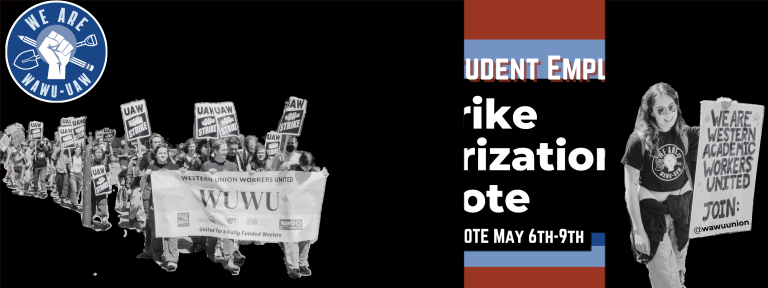
Strike Authorization Vote Closes In
Day(s)
:
Hour(s)
:
Minute(s)
:
Second(s)
OPERATIONAL STUDENT EMPLOYEES AT WESTERN WASHINGTON UNIVERSITY ARE FIGHTING FOR EQUITY WITH OUR ESE COUNTERPARTS
We are 1,100 Western students working as Resident Advisors, Laborers, Program Support Staff, Writers/Editors, Clerks, Attendants and more at Western Washington University
Vote YES on the SAV NOW to authorize the OSE bargaining team to call for a strike if WWU Admin continues to REFUSE our majority demand for recognition and a fair contract.
Our Strike Authorization Vote is happening NOW! (May 6th-9th)
Take a look at the answers to some frequently asked questions to be fully prepared to vote YES!
This page will be updated with more FAQs informed by workplace meetings and organizing conversations. Don’t see your question below? Reach out to contact@wawu-union.org
What is a Strike Authorization Vote?
A Strike Authorization Vote (SAV) is a vote whether or not to give our bargaining team the authority to call a strike if WWU Admin continues to ignore our demands for recognition and equal contract protections to Educational Student Employees. If a two-thirds (⅔) majority of Operational Student Employees (OSEs) votes YES, this would allow our bargaining committee to set a strike deadline. A deadline would be set if admin continues to stonewall us about the recognition process and ignore our demands for equal contract protections and the bargaining committee decides that a strike is necessary to win our best first contract. A Strike Authorization Vote does not automatically mean we will go on strike, nor does it mean a strike would be called immediately following the vote. Any decision to go on strike will be made with additional input of all of us.
Majority participation in the SAV demonstrates a powerful threat to university operations and may effectively pressure the university into recognizing us and giving us equity with Educational Student Employees who currently have a contract without us actually having to do a work stoppage.
Why are we considering a Strike Authorization Vote now?
A majority of OSE have decided we want a union TWICE (2) in the last 16 months!! And the admin continues to not recognize our union and bargain a fair contract with us. They’ve falsely claimed that without a statutory framework, in the form of a bill in the state legislature, they can’t move forward in counting our majority of union authorization cards to recognize our unit and bargain a fair contract. Voluntary recognition agreements have been reached through cooperation between employees and their employer, Western can recognize us at any time. By ignoring our demands and refusing to meet with us, admin is choosing to deny OSEs an equal say in our workplaces and equal contract protections to ESEs.
A composite group of OSEs have expressed that their workplace issues can be addressed through equal implementation of the ESE contract, priorities include:
- Job security and Layoff protections
- Grievance procedure to hold WWU accountable to the contract we bargain
- Fair scheduling
- Workspace and Materials
- Increased Sick time + bereavement Leave
It is possible for Western to recognize and meet our demands and uphold their commitment to equity. We want to work with them to change the systematic underfunding of higher education together at the state legislature, but we can’t when we are currently fighting for basic protections and recognition.
A strong majority of OSEs voting YES! in the SAV gives the bargaining committee the authority to call a strike if Admin continues to deny us recognition and equity with ESEs. it also sends a powerful message to Western that we are united and prepared to fight to protect college affordability and a say in our workplaces. We hope that WWU Administrators work quickly avert a strike by recognizing OSEs and coming to the table. However, if they continue to deny us a say in our workplaces, we need to be prepared to exercise our legal right to strike. We are holding them accountable and there will be consequences if they continue to refuse to recognize our union and grant us equity with ESEs.
How does the Strike Authorization Vote Work?
In order to authorize a strike, a two-thirds (⅔) majority of voting OSEs must vote YES. A vote would be conducted via jotform and was emailed to everyone on the 6th.
The more OSEs who vote, and the more OSEs who vote YES! the stronger the message we send to WWU Admin that we will not back down until they recognize our unit and agree to equally apply the ESE contract to OSEs. We can potentially come to an agreement and avoid a strike with a strong majority YES SAV!
If I vote YES! in the Strike Authorization Vote, will I be required to go on strike?
A YES! vote in the SAV does not obligate you to participate in a strike. This vote authorizes our Bargaining Committee to call a strike this quarter if Western continues to deny recognition and equity to OSEs. The more of us who vote YES! the more likely that WWU will bargain in good faith to reach a fair agreement to avoid us all withholding our labor. The same is true if WWU continues to bargain in bad faith, and the Bargaining Committee determines that a strike is necessary to win our best contract. While a YES! vote is not a binding contract to withhold your labor, a strike will only be successful with mass participation. If going on strike is what it ends up taking to show Western that we’re serious, the more of us who join the picket line, the more likely we are to make history as the first recognized Operational (non-educational) student worker union in Washington state w/ a contract.
What would a strike look like?
A strike is a complete work stoppage. During a strike, OSEs would not perform any of our work duties (custodial work, managing front desks, and helping residents, in non-emergency situations), but instead participate in picket lines or other strike activities in and around our campus to increase the visibility of the strike. The more concrete details of a strike would be shared through folks in your workplace if the conditions in bargaining warrant the WAWU Bargaining Committee to set a strike deadline
What protections do we have against retaliation?
If Western decides to retaliate against student workers fighting for equity and protections, not only will they face public backlash that will tarnish their institutional reputation as employers from our unit of 1200 Operational Student Employees, but also 1100 Educational Student Employees, 2700 unionized faculty and staff working at Western, and over 10,000 United Auto Worker siblings across the state. Swift public campaigns denouncing retaliation has effectively reinstated hundreds of workers across the country and more recently successfully reinstated folks unionizing at Central Washington University.
We will support and protect each other, and work with our affiliated United Auto Workers (UAW) leadership and representatives to navigate legal or other challenges as they arise.
During the ESE strike last year, because there was majority participation, no one was fined or disciplined, and no union was sued.
As with all union actions, our best protection against employer retaliation is our commitment to each other and our willingness to stand together in public; our greatest strength is our numbers and our solidarity.
Would it be legal for us to go on strike?
There is no statute that grants the express right to strike nor prohibits strikes for a unit of Operational Student Employees, thus an OSE strike is not prohibited by law. Holding a strike authorization vote and going on strike to win recognition is not in violation of any legal statues and is not illegal.
Last year, Educational Student Employees ~1100 of our coworkers, went on strike for 2 days for a fair contract and won the first cost of living adjustment for student workers in years, layoff protections, and a democratic say in their workplaces. Student Employees at the University of Washington voted to authorize and then executed a one-day strike in 2018 and a 15 day strike in 2001.
None of the workers mentioned above were fined or disciplined, and no union was sued.
As with all other union actions, our best protection against employer retaliation is our commitment to each other and our willingness to stand together in public; our greatest strength is our numbers and our solidarity.
If Western decides to retaliate against student workers fighting for equity and protections, not only will they face public backlash that will tarnish their institutional reputation as employers from our unit of 1200 Operational Student Employees, but also 1100 Educational Student Employees, 2700 unionized faculty and staff working at Western, and over 10,000 United Auto Worker siblings across the state. Swift public campaigns denouncing retaliation has effectively reinstated hundreds of workers across the country and more recently successfully reinstated folks unionizing at Central Washington University.
We will support and protect each other, and work with our affiliated United Auto Workers (UAW) leadership and representatives to navigate legal or other challenges as they arise.
Am I allowed to strike if I am a work study student employee?
Yes. Your source of funding doesn’t affect your standing as an employee included in this bargaining unit.
What kind of protections are there for international or undocumented OSEs who go on strike?
International and undocumented workers can and do participate in union activities–up to and including voting in a Strike Authorization Vote and going on strike–to the same extent that domestic workers can and do. Times are deeply uncertain for international and undocumented workers, and the best way to protect each other is to show up in droves to stand together in public and stand in solidarity. In particular, your vote in the Strike Authorization Vote is confidential and WWU will never know who participated in the vote, let alone HOW you voted. Only the total number of yes votes will be publicly shared, so voting YES and adding to that majority is the best way to anonymously show WWU that we’re willing to withold our work if they keep witholding our recognition and protections.
How long would a strike last? When would it start and end?
Decisions about the date and length of a strike would be collective decisions made by OSEs. Last year, the ESE strike effectively shut down campus operations for 2 days and management was pressured by students, faculty, staff, and the community to accept our contract demands, effectively ending the strike.
OSEs across campus are organizing and will continue meeting to discuss what it would look like to withhold labor and to ensure mass participation in picket lines and other strike activities. If you are not already connected with other organizers in your area, reach out to contact@wawu-union.org to get connected and involved!
If we go on strike, will I be paid?
If we go on strike and withhold our labor, WWU may refuse to not pay us. In the event of a strike, OSEs who complete strike duties will be eligible for $500 per week of strike pay from our affiliate union’s, United Auto Workers (UAW), strike fund. The strike fund exists because of the hundreds of thousands of workers across the UAW who contribute membership dues, allowing all of us to have this collective resource that enables us to exercise our power.
How would I access strike pay and benefits?
As workers represented by UAW, we have access to UAW’s Strike and Defense Fund after losing pay for participating in a sanctioned strike. Strike benefits are $500 per week in strike pay, along with medical benefits in the event that WWU withholds healthcare. Any OSEs who participate in strike activities will receive strike pay. There are resources for exceptional circumstances, and we can also establish a hardship fund that can provide further assistance to workers who experience emergency financial hardship due to lost pay.
Am I eligible for strike benefits if I’m an international or undocumented worker?
Yes. Strike pay of $500 per week is available to all workers, regardless of citizenship status. Support from the strike fund is not categorized as wages from employment and does not interfere with work limitations associated with student visas.
Will Western care if we decide to go on strike?
Absolutely. OSEs make WWU run by performing work essential to the functions of this university. We open buildings, we take out the trash and recycling, we make sure that all students get what they need, we run tests, write the news, we run this school.
Not only would a strike shut down the Western’s central activities, it would also be highly visible. Workers, community members, and elected officials across the state and country came to support the ESE picket line last year, and many members of other unions will support by refusing to cross the picket line or perform our jobs for us.
If we strike, there will be significant press coverage, which will pressure management by publicizing their decision to deny us recognition and equity. By putting pressure on WWU in multiple ways, an OSE strike would definitely have a major impact.
Would going on strike hurt my academic progress?
No. If striking becomes necessary, it would be because of Western refusing to agree to a fair contract. At that point the University would have forced OSE to feel that we need to choose between our dedication to our work and our need for fair working conditions. WWU can choose to agree to a fair contract at any time, and when they do, we will all be able to learn and work at a university that supports us much better.
Going on strike is a collective choice to put our work on hold in the short term in order to make our working conditions, our University, and higher education better for everyone in a lasting way. A strike does mean we would put our work on hold, but it doesn’t mean we would discontinue our academic obligations. OSEs care about our work, and we will work together to discuss how we would strike in a way that allows us to win what we deserve and get back to serve our campus community.
What if my work duties and my academic research are closely related?
For many of us, the research that we conduct serves as both our source of income and data for the projects associated with completing our degrees. If striking becomes necessary, it would be because of Western refusing to agree to a fair contract. At that point the University would have forced ESEs to feel that we need to choose between our dedication to our work and our need for fair working conditions. WWU can choose to agree to a fair contract at any time, and when they do, we will all be able to do our teaching, research and more in a university that supports us much better. If we are forced to go on strike to win a fair first contract, it is most effective (and therefore, shorter) if everyone is withholding every kind of labor that we get paid for – including any research work.
It is ultimately WWU’s responsibility to make sure that any basic maintenance necessary to continue research happens during a strike. However, there are also ways that you can prepare for a potential strike. These plans could include advance-planning your experiments or informing your Primary Investigator that they may need to make alternative plans to ensure that any time-sensitive research or specimen care occurs. It can also be incredibly effective to have the Primary Investigator of your research project put pressure on the University to agree to our demands if we go on strike. If a strike becomes necessary, there would be resources available for ESEs to share with our PIs, supervisors, and advisors about how they can help resolve the strike.
Would going on strike hurt the students who depend on my work?
Our working conditions are our students’ and peers’ learning conditions. Until OSEs are treated fairly and equitably, the students who rely on us are worse off. Fortunately, students and staff have been expressing broad support for our campaign for a fair contract. In other Student Employee strikes, non-employed students have organized support by turning out to picket lines, creating petitions, and more–this kind of solidarity can increase the power of a strike and help put pressure on WWU Admin to agree quickly to fair working conditions.
OSEs can prepare non-employee students by talking to them about what’s going on and what they can expect during a strike: the normal work an OSE would perform would be left undone for the duration of the strike. If a strike becomes necessary, there will be resources available for OSEs to share with our residents and peers about how they can help pressure the university to end the strike.
It can be helpful to remind ourselves and our students that admin has always had the power to avert or end a strike by recognizing OSEs and giving us an equal say in our working conditions. Any effect of our work stoppage is because the University has denied respect to its workers.
How can non-OSEs help with a potential strike?
If you are an ESE, in the case of an OSE strike, we ask that you pledge to respect our Strike—just as we did yours during your 2 day strike last year.
If you are a community member, email admin and demand that the university recognize our union and give us equal protections to ESEs.